A beautiful home is not simply a collection of expensive materials and furniture. It is a space where planning, storage, lighting, materials and everyday functionality work together.
Modern homeowners increasingly want interiors that look sophisticated but are also practical to maintain and adaptable to changing lifestyles.
This is where modular interior design can play an important role.
From kitchens and wardrobes to storage systems and customized furniture, modular solutions can help organize a home without compromising its visual character. When combined with thoughtful architectural planning and bespoke details, they can work equally well in contemporary apartments, luxury villas and renovated residences.
The objective should not be to make every home look standardized. It should be to use efficient systems intelligently while retaining the personality of the space.
What Is Modular Interior Design?
Modular interiors use components designed and manufactured in standardized or customizable modules before being assembled on site.
The most familiar examples are modular kitchens and wardrobes, but the approach can extend to:
- TV and entertainment units
- Storage walls
- Study units
- Walk-in wardrobes
- Bar units
- Bookshelves
- Utility storage
- Bathroom vanities
- Home-office furniture
- Display units
One of the major advantages is planning accuracy.
Dimensions, internal storage, hardware and finishes can be decided before manufacturing begins. This can reduce excessive on-site fabrication while providing a cleaner and more organized installation process.
However, modular doesn’t have to mean repetitive.
Materials, proportions, handles, internal accessories and surrounding architectural details can all be customized to suit the overall interior.
Modular vs Custom Interiors: Which Is Better?
It doesn’t necessarily have to be one or the other.
In many premium residences, the strongest solution is a combination of both.
A kitchen, for example, may use modular internal cabinets for efficient storage while the external finishes, stone countertop, lighting and surrounding panelling are customized to match the architecture.
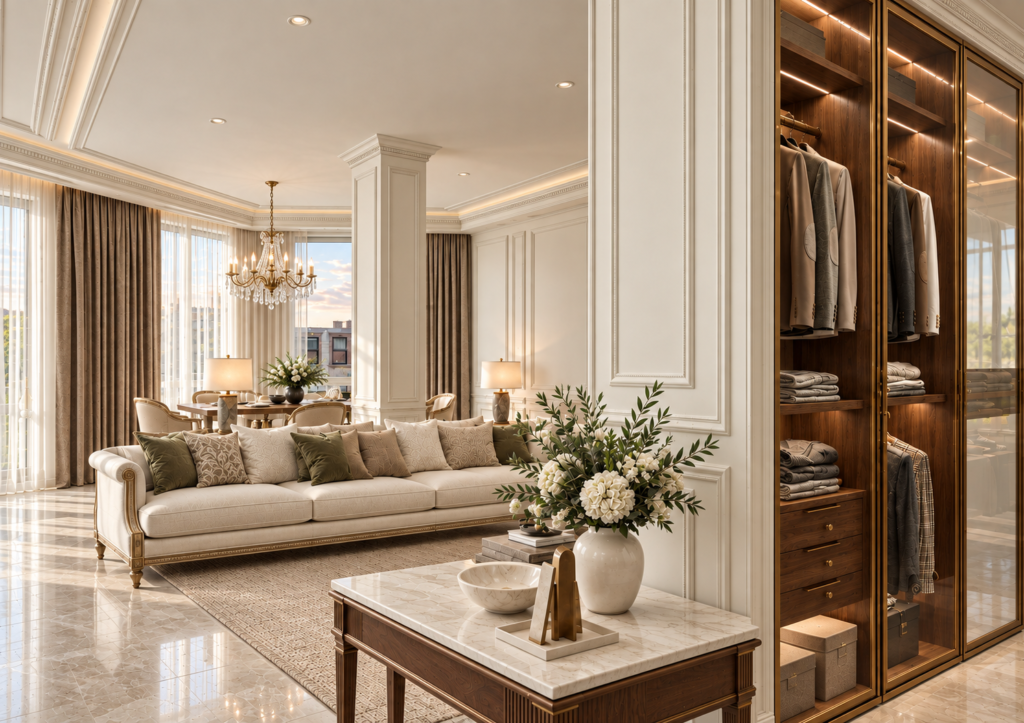
Similarly, wardrobes can use modular internal organization while their shutters are designed specifically for the room.
Custom furniture may be preferable where dimensions, proportions or architectural conditions are unusual.
The right approach depends on the space rather than following one system throughout the entire home.
What Do Residential Interior Designers Actually Do?
Professional residential interior designers do much more than select furniture and colours.
A home contains hundreds of interconnected decisions.
Consider a bedroom.
The bed position affects side tables and electrical points. Wardrobe depth affects circulation. Air-conditioning influences ceiling details. Curtains need to coordinate with windows. Lighting should respond to furniture placement.
If these decisions happen independently, problems often appear during execution.
A residential interior designer brings them together through planning and detailed drawings.
The scope can include:
- Furniture planning
- Interior concepts
- 3D visualization
- Flooring layouts
- Ceiling design
- Lighting
- Electrical planning
- Wardrobes
- Kitchens
- Bathrooms
- Custom furniture
- Material selection
- Soft furnishings
- Artwork
- Site coordination
The objective is to create a consistent experience rather than designing every room independently.
Beautiful Interior Design Starts With Planning
When people think of beautiful interior design, they often think first about marble, chandeliers, furniture or decorative walls.
But beauty usually starts with proportion.
A living room can contain expensive furniture and still feel uncomfortable if the pieces are too large for the space.
Similarly, a dramatic ceiling can make a room feel lower if its proportions aren’t appropriate.
Before choosing finishes, designers should understand:
How will people move through the room?
Where will the main furniture sit?
Which element should become the focal point?
How much storage is required?
Where does natural light enter?
Once these questions are resolved, materials and decoration can strengthen the design rather than trying to compensate for poor planning.
Luxury Is Not About Filling Every Surface
One common misconception is that luxury interiors require every wall, ceiling and floor to become a design feature.
Usually, the opposite works better.
If a room already has beautiful natural stone flooring, perhaps the walls can remain quieter.
If there is an important artwork, the surrounding wall treatment doesn’t need to compete with it.
If a sculptural chandelier is the focal point, excessive ceiling detailing may reduce its impact.
Luxury often comes from knowing where to stop.
A limited material palette, comfortable furniture, appropriate lighting and a few strong details can create a more sophisticated interior than using expensive finishes everywhere.
What Is Renovation Interior Design?
Renovation is different from designing a completely new home because the designer has to work with existing conditions.
Renovation interior design begins by understanding what should remain, what needs improvement and what genuinely needs replacement.
An existing home may have good structural proportions but outdated interiors.
In that situation, changing flooring, lighting, furniture, kitchens, bathrooms and wall finishes may create a major transformation without unnecessarily rebuilding everything.
Another property may require more substantial intervention, such as changing room relationships or improving circulation.
A renovation therefore needs careful evaluation before demolition begins.
What Should You Check Before Renovating a Home?
Before deciding what to change, understand the existing building.
Important areas to inspect can include:
- Structural condition
- Plumbing
- Electrical systems
- Waterproofing
- Doors and windows
- Flooring
- Ceiling heights
- Air-conditioning
- Natural light
- Ventilation
- Existing storage
- Wall locations
This assessment helps distinguish between cosmetic improvements and problems that need technical attention.
For example, repeatedly repainting a wall will not solve moisture caused by failed waterproofing.
Similarly, installing a new modular kitchen without first checking old plumbing and electrical services can create problems later.
Good renovation planning deals with the underlying issues before adding the decorative layer.
Searching for a Home Renovation Architect Near Me?
Homeowners often search for a home renovation architect near me when an existing property needs more than cosmetic improvement.
An architect becomes particularly useful when the renovation involves changes to planning, openings, staircases, façades, room relationships or other architectural elements.
Before appointing someone, review their experience with renovation projects rather than only new construction.
Renovation requires a slightly different mindset.
The designer needs to understand what can be retained and how new work will connect with existing construction.
Ask about:
- Existing-site assessment
- Proposed planning changes
- Structural coordination
- Interior design
- Services coordination
- Working drawings
- Material selection
- Site supervision
A nearby architect can make site coordination convenient, but experience and project compatibility remain more important than distance alone.
Renovate Rather Than Replace Everything
One of the smartest renovation decisions can be identifying what is already worth keeping.
Natural stone flooring may only require polishing.
Good-quality wooden doors can potentially be refinished.
Existing furniture may be reupholstered.
A staircase might need only new railing and lighting rather than complete replacement.
This approach can preserve character while directing the renovation budget toward areas where it makes a greater difference.
It can also prevent a renovated home from feeling completely disconnected from its original identity.
Kitchens Need Function Before Appearance
The kitchen is one of the strongest applications for modular planning.
Before selecting cabinet colours, understand how the kitchen will actually be used.
Consider:
- Refrigerator position
- Sink
- Hob
- Preparation area
- Appliances
- Pantry storage
- Crockery
- Waste management
- Frequently used utensils
- Electrical requirements
A beautiful kitchen that creates unnecessary movement between the refrigerator, sink and cooking area can quickly become frustrating.
Storage should also be designed around actual requirements rather than simply creating the maximum possible number of cabinets.
Wardrobes Should Be Designed From the Inside Out
Wardrobe design often begins with the external finish.
It should ideally begin with what needs to be stored.
Hanging requirements, folded clothing, drawers, shoes, accessories, luggage and seasonal items can determine the internal configuration.
Once the internal organization works, the external shutters can be coordinated with the room.
This is where modular systems can be particularly useful because internal components can be planned systematically while the exterior remains customized.
Lighting Can Make or Break an Interior
Lighting should be considered during design—not after the ceiling is complete.
Good residential lighting usually works in layers.
Ambient lighting provides general illumination.
Task lighting supports activities such as reading, cooking and dressing.
Accent lighting highlights artwork or architectural details.
Decorative fixtures add character.
The most comfortable rooms rarely rely on only one type of lighting.
For renovation projects, lighting upgrades can sometimes transform the atmosphere of an existing home without major architectural intervention.
Frequently Asked Questions
Is modular interior design suitable for luxury homes?
Yes. Modular systems can be combined with bespoke materials, custom furniture and architectural detailing. The result depends on how the system is designed and integrated rather than simply whether it is modular.
Is modular furniture better than carpenter-made furniture?
Neither is universally better. Modular systems can offer manufacturing consistency and organized installation, while custom site-made work can be useful for unusual conditions. Many homes benefit from combining both.
When should I hire an interior designer for renovation?
Ideally, before demolition or material purchasing begins. Early planning helps determine what should remain, what needs technical repair and what should be redesigned.
Should an architect be involved in an interior renovation?
If the renovation affects the building layout, structure, façade, major openings or architectural planning, involving an architect can be particularly useful.
How can I make my interiors look more luxurious?
Focus on good proportions, coordinated materials, comfortable furniture, layered lighting and quality detailing. Avoid trying to make every surface a focal point.
Design for the Way You Actually Live
The strongest residential interiors are not necessarily the ones with the most decoration.
They are the ones where everything seems to belong.
Storage is where you need it. Furniture fits the room. Lighting supports different moods. Materials work together. Architecture and interiors communicate.
Whether you are planning a new residence or exploring renovation interior design, thoughtful planning should come before decoration.
A successful modular interior design approach can bring organization and efficiency, while customized elements add the individuality that makes the home personal.
The role of experienced residential interior designers is to find the right balance between the two.
Planning a New Interior or Home Renovation?
For luxury residential interiors, architecture, renovation, landscape design and customized home solutions, connect with Meraki Architectural Consultants.
Website: https://merakiarcht.com/
Call / WhatsApp: +91 9211961199
Instagram: https://www.instagram.com/mac.architects
Studio: A-1203, A-Tower, Sector 132, Noida – 201304
A successful renovation shouldn’t simply make an old home look new—it should make the home work better for the way you live today.